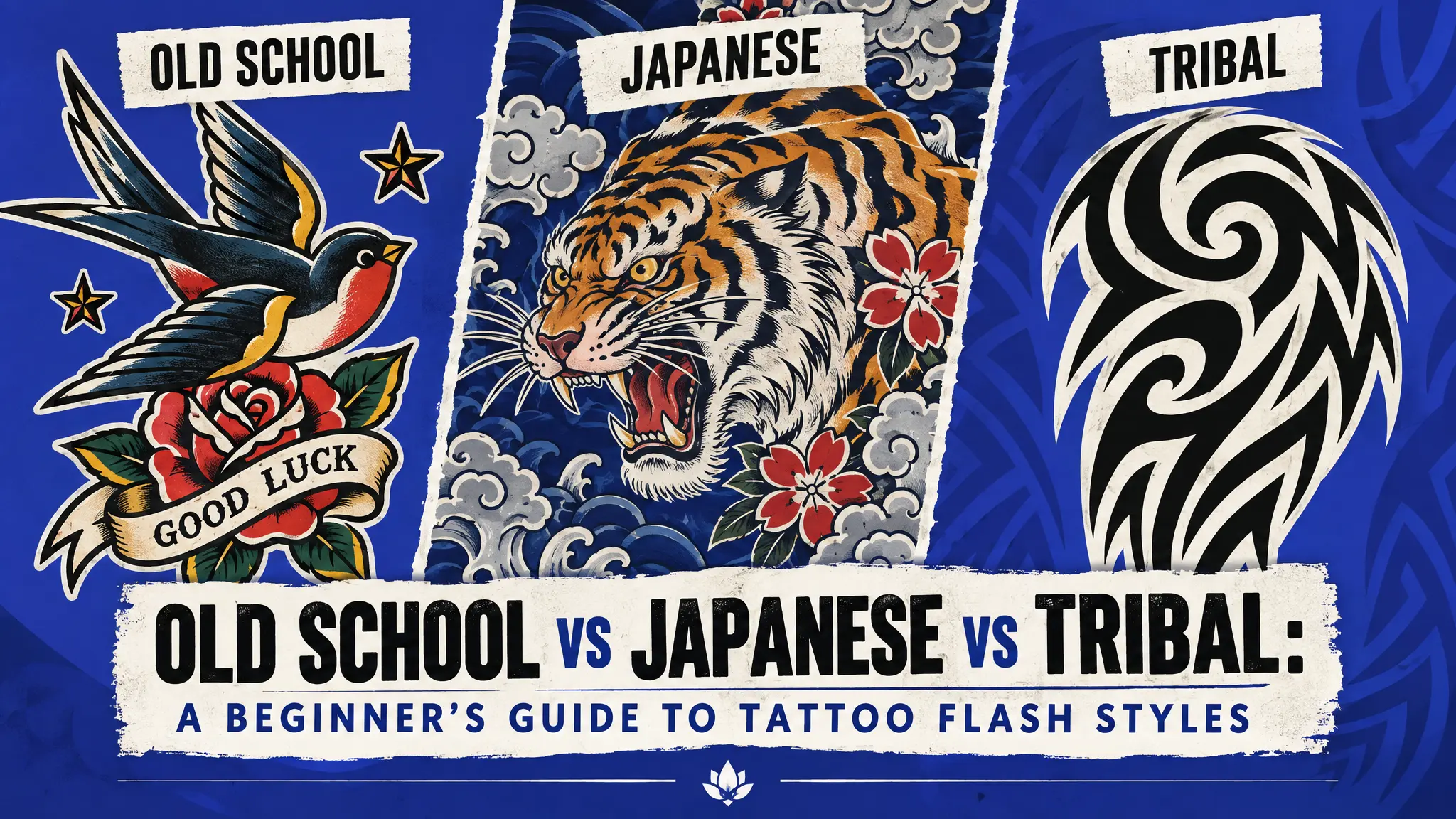
Walk into almost any tattoo shop and you’ll see walls covered in sheets of pre-drawn designs. That’s called flash. The classic tattoo flash styles have shaped how we think about tattoos for more than a century, and today they’re also some of the most popular looks in graphic design, on T-shirts, stickers, posters and packaging.
This guide explains three classic tattoo flash styles: old school (American traditional), Japanese and tribal. You’ll learn where each style comes from, how to recognize it, and how to use it in your own projects.
What is tattoo flash?
Tattoo flash is a set of ready-made designs, traditionally drawn on paper sheets and hung on a shop’s wall. Customers could pick a design, and the artist would tattoo it more or less as drawn. Flash made tattooing faster, gave shops a recognizable style, and created a shared visual language: swallows, roses, daggers, dragons and skulls.
Today flash is still sold and collected, and “flash-style” illustrations are used far beyond skin.
Style 1: Old school (American traditional)
Where it comes from
Old school tattooing grew in the early-to-mid 20th century, especially among sailors and in port cities. Artists like Norman “Sailor Jerry” Collins helped define the look that most people now picture when they hear “traditional tattoo.”
How to recognize it
- Bold black outlines that stay readable even after years on skin
- A limited color palette: red, green, yellow, black and sometimes blue
- Solid color fills with simple black shading
- Iconic motifs: swallows, anchors, roses, daggers, hearts with banners, eagles, panthers, ships and pin-up girls
Where it works in design
Old school art is bold and simple, so it works at small sizes. It’s great for stickers, patches, enamel pins, barbershop branding, streetwear and band merch.
Browse Oldschool Tattoos 01, 02 and 03, plus Flash Tattoos 01.
Style 2: Japanese (irezumi-inspired)
Where it comes from
Japanese tattooing has a long history and was strongly influenced by Edo-period woodblock prints (ukiyo-e). Traditional Japanese work often covers large areas, like a full back or sleeve, with one flowing composition.
How to recognize it
- Large, flowing compositions that follow the shape of the body
- Background elements like waves, clouds, wind bars and falling petals that tie everything together
- Rich symbolism: koi fish (perseverance), dragons (strength and wisdom), tigers (courage), peonies (wealth and good fortune), cherry blossoms (the beauty of short-lived moments) and hannya masks
- Bold outlines with smooth shading
Where it works in design
Japanese-inspired art shines at larger sizes: posters, jacket backs, skateboard decks, wall art and restaurant interiors. Individual motifs like a koi or a wave also work as smaller logos or prints.
See Japanese Tattoo 01 and Japanese Tattoo 02. For wave backgrounds, Ocean Waves 01 is a good match.
Style 3: Tribal
Where it comes from
“Tribal” is a broad label. It is inspired by the traditional tattooing of many cultures, including Polynesian, Māori and Bornean traditions, where designs carry deep personal and cultural meaning. In the 1990s, a Western “tribal” trend took these ideas in a new direction: solid black, sharp, flowing shapes with no specific cultural meaning.
When you use tribal-inspired art, it’s worth knowing this difference. Some traditional patterns, like Māori tā moko, are culturally significant and personal, so it’s respectful not to copy them. Modern, abstract tribal designs are the safer choice for everyday graphic projects.
How to recognize modern tribal
- Solid black shapes with no shading
- Sharp points and flowing curves
- Symmetry, often mirrored around a center line
- Motifs: stars, butterflies, suns, flames and armbands
Where it works in design
Tribal designs are high contrast, which makes them perfect for vinyl cutting, stencils, laser engraving and one-color printing. They’re currently popular again thanks to Y2K fashion and the newer “cyber” styles.
Explore Tribal Butterflies 01, Tribal Stars 3D 01 and Cyber Tribalism 01.
Quick comparison
- Old school: bold lines, limited colors, small iconic motifs. Best for stickers, patches and merch.
- Japanese: large flowing scenes, rich symbolism, background waves and clouds. Best for posters, apparel backs and wall art.
- Tribal: solid black, sharp curves, symmetry. Best for vinyl, stencils, engraving and one-color prints.
Honorable mention: sketchy flash
Not every flash design is polished. Sketch-style flash keeps the loose, hand-drawn lines of an artist’s first draft. It feels raw and personal and works well for zines, album covers and alternative fashion. Take a look at Sketchy Tattoo Flash 01 and Only Skulls.
How to use tattoo flash in your own designs
- Pick one style per project. Mixing old school and Japanese on one shirt usually looks messy.
- Respect the color rules. Old school looks wrong in pastel; tribal loses impact in color.
- Add a banner or lettering. Text banners are a classic flash element. Add a name, a date or a short phrase.
- Use SVG for cutting and large prints. Tattoo-style art has lots of crisp edges that should stay sharp.
Want to try these designs on your own skin before committing? Our guide to printing temporary tattoos at home shows you how.
FAQ: tattoo flash styles
Can I get a real tattoo from your designs? Many people use our designs as reference or inspiration. For a real tattoo, bring the design to your artist and let them adapt it to your body and skin. A good artist will adjust line weights for longevity.
Can I use tattoo-style graphics on products I sell? Yes, with our Pro plan’s commercial license. See Pricing and the Terms of Use for the full rules.
Which style is easiest for beginners in design? Old school. Bold lines and a small palette are forgiving, and the motifs are instantly recognizable.
Find your style
Whether you love bold swallows, flowing koi or sharp tribal curves, there’s a flash style for every project. Start with Oldschool Tattoos 01 or Japanese Tattoo 02 and see which one speaks to you.